Research
Overview
We treat psychological interventions as structured inputs that induce learning and use computational models to specify how this learning unfolds. This allows us to move beyond descriptive accounts of therapy towards mechanistically defined processes that can be measured and empirically tested.
Projects
Selective Maintenance and Return of Fear
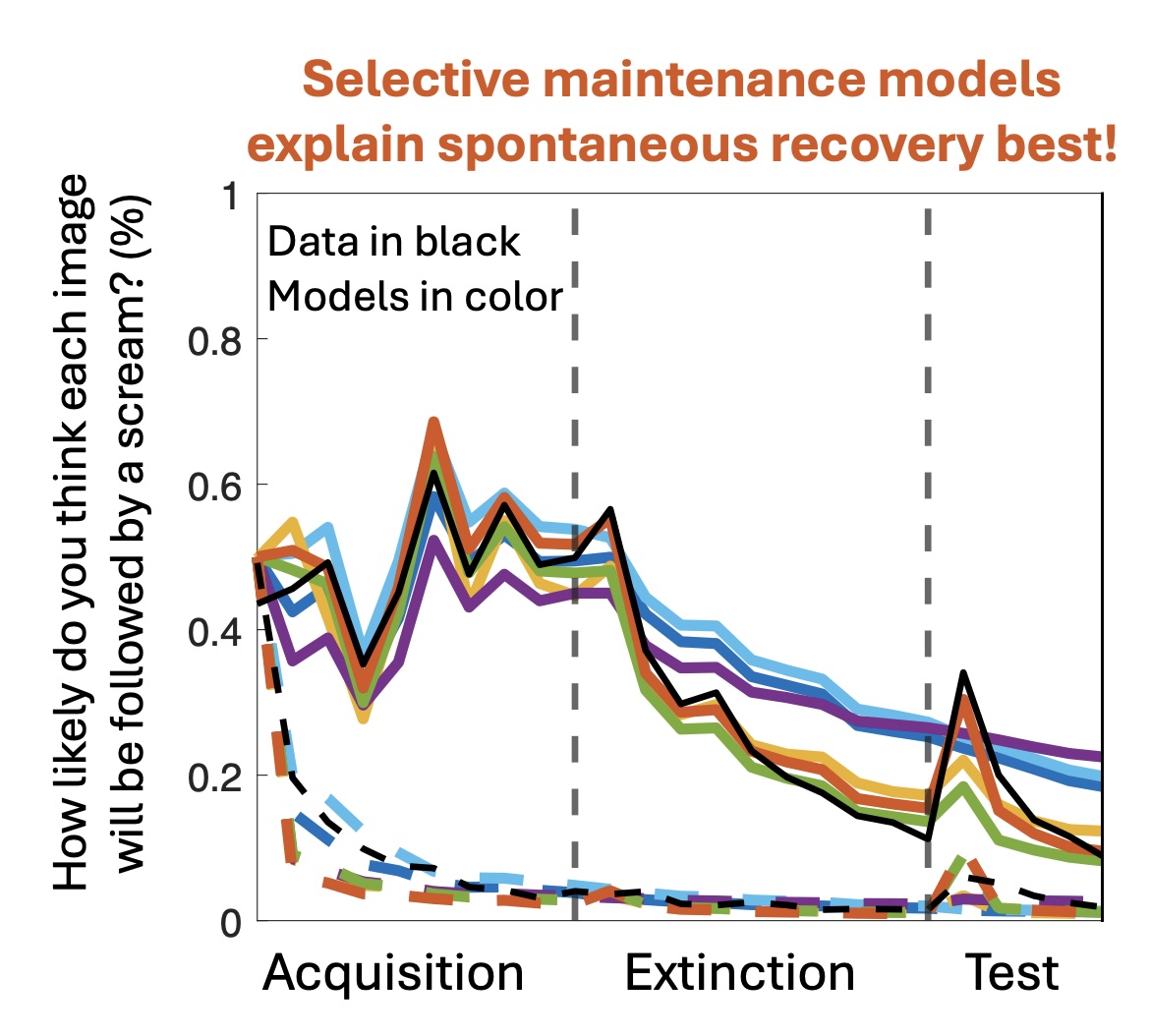
This project examines why fear can return after successful exposure therapy. We propose that selective maintenance of aversive memories contributes to this phenomenon and test this hypothesis using a combination of behavioural experiments, computational modelling, neuroimaging, and a clinical trial.
The project consists of three closely linked components. First, a behavioural study tests the proposed mechanism in an experimental setting using a task designed to capture fear learning and extinction. Second, a neuroimaging study focuses on the neural signatures of memory reactivation and maintenance. Third, a clinical trial uses online exposure-based interventions to examine whether targeted modifications can reduce return of fear.
This work is funded through a Wellcome Trust Mental Health Award and is conducted in collaboration with Princeton University.
Relevant publications:
Berwian, IM., Ren, Y., Pisupti, S., Ding, J., Moon, S., Chiu, J., Chandrasekhar, D., & Niv, Y. (under review).
Selective maintenance of aversive memories as a mechanism of spontaneous recovery of fear.
PsyArXiv.
[DOI]Berwian, IM., Pisupati, S., Chiu, J., Ren, Y., & Niv, Y. (2024).
Selective maintenance of negative memories as a mechanism of spontaneous recovery of fear after extinction.
Proceedings of the Annual Meeting of the Cognitive Science Society (Vol. 46).
[Link]
Predicting Response to Behavioural Activation vs Cognitive Restructuring

This project focuses on identifying which individuals benefit from different components of cognitive behavioural therapy. Although cognitive restructuring (CR) and behavioural activation (BA) are widely used interventions, there are currently no evidence-based methods to determine which individuals should receive which component.
We test the hypothesis that different learning capacities are required for CR and BA and that these capacities can be quantified using computational variables derived from behavioural tasks.
In a clinical trial that we recently completed, participants undertook questionnaires and behavioural tasks assessing learning processes and were then randomly assigned to either a BA or a CR intervention delivered over five weeks using a self-help tool.
Combining theory-driven models of learning with cross-validated predictive modelling with separate training and test datasets, we aim to develop models that predict symptom change and differential response to CR versus BA. The goal is to identify task-derived variables that can guide intervention selection at the individual level.
Relevant publications:
Ding, J., Chiu, J.C., Moon, S., Ren, Y., Turner, D.M., Shoval, G., Niv, Y., & Berwian, IM. (2026).
Protocol for a randomized trial to predict the efficacy of cognitive and behavioral interventions for symptoms of depression.
Frontiers in Psychiatry.
[Paper]Berwian, IM., Hitchcock, P., Pisupati, S., Schoen, G., & Niv, Y. (2025).
Using computational models of learning to advance cognitive behavioral therapy.
Communications Psychology, 3(72).
[Paper]Reiter, AM., Atiya, NA., Berwian, IM., & Huys, QJM. (2021).
Neuro-cognitive processes as mediators of psychological treatment effects.
Current Opinion in Behavioral Sciences, 38, 103–109.
[Paper]
Predicting Response Across Interventions for Depression
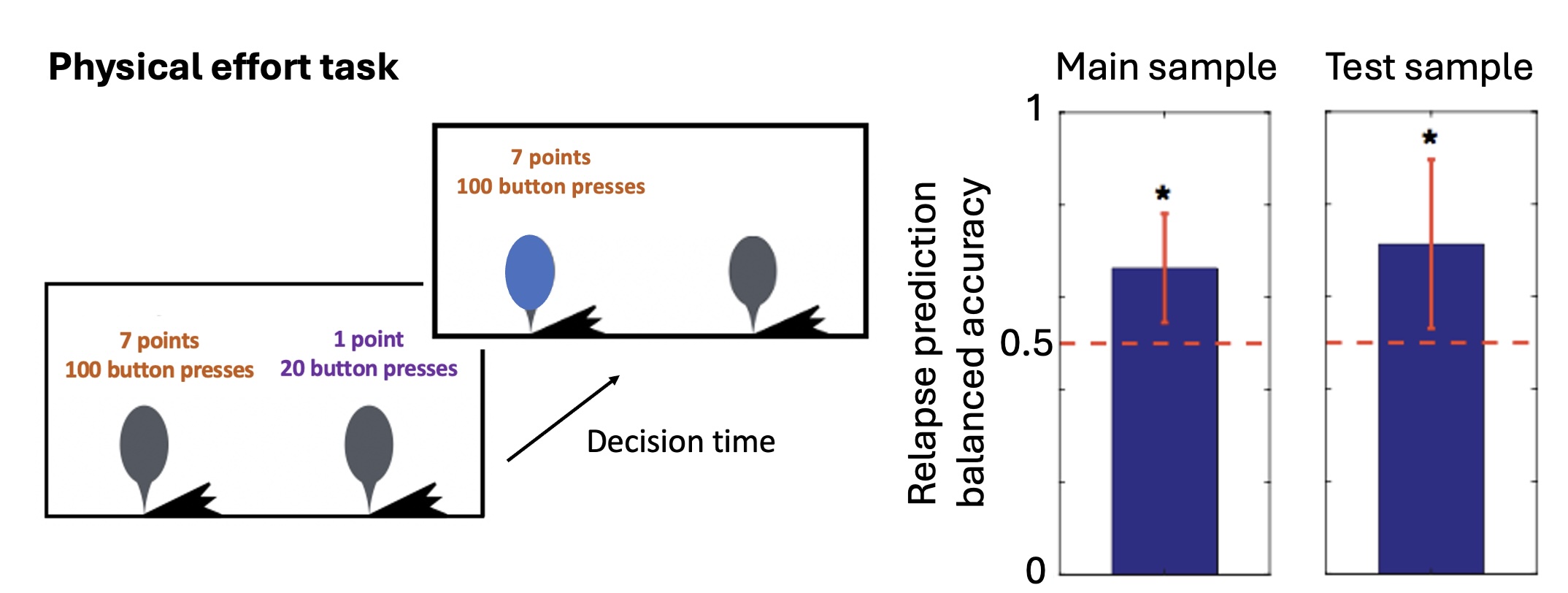
This project extends the prediction of treatment response across a broader range of interventions for depression, including psychological, pharmacological, and neuromodulatory approaches.
It combines computational modelling of behavioural task data with causal machine learning approaches. The work builds on collaborations across multiple clinical studies in which harmonised behavioural tasks were collected.
We examine whether task-derived parameters predict treatment outcomes, how these parameters change due to interventions, and whether their predictive value differs across treatment types. The goal is to develop decision tools grounded in computationally defined mechanisms.
Relevant publications:
Brakemeier, E.-L., Klein, J.P., Zimmermann, J., …, Berwian, IM., et al. (2026).
Efficacy, moderators and mediators of cognitive behavioural analysis system of psychotherapy (CBASP) versus behavioural activation (BA) in persistent depression.
BMJ Open.
[Paper]Berwian, IM., Wenzel, JG., Collins, AGE., Seifritz, E., Stephan, KE., Walter, H., & Huys, QJM. (2020).
Computational mechanisms of effort and reward decisions in depression and their relationship to relapse after antidepressant discontinuation.
JAMA Psychiatry, 77(5), 513–522.
[Paper]
Psychodynamic Psychotherapy Project
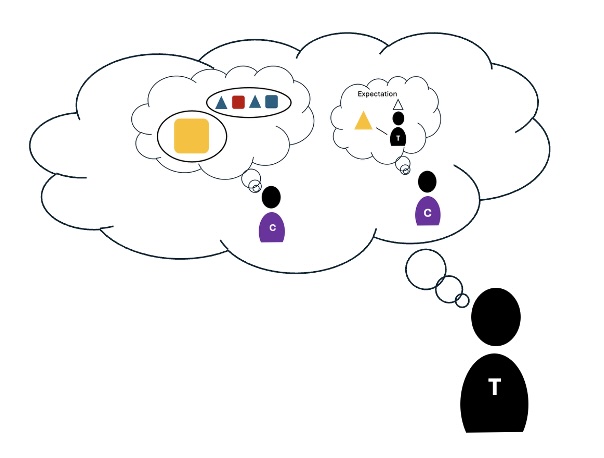
This project develops a computational framework to examine mechanisms of psychodynamic change. It focuses on how maladaptive interpersonal expectations, such as anticipating rejection or hostility, arise and how they are modified in therapy.
The current project focuses on distinguishing between experiential change (driven by new interpersonal experiences) and reflective change (driven by higher-level belief updating). A computational model formalises these processes and generates predictions that are tested in behavioural experiments.
The broader goal is to establish a formal bridge between psychodynamic theory and computational models of learning, and to ground key psychodynamic concepts such as transference, mentalization, and rupture and repair in a computational framework.
Publications on related topics:
Dulburg, Z., Dubey, R., Berwian, IM., & Cohen, J. (2023).
Having multiple selves helps learning agents explore and adapt in complex changing worlds.
PNAS, 120(28).
[Paper]Story, GW., Smith, R., Moutoussis, M., Berwian, IM., Nolte, T., Bilek, E., & Dolan, RJ. (2023).
A social inference model of idealization and devaluation.
Psychological Review, 131(3), 749–780.
[Paper]